
React Basic
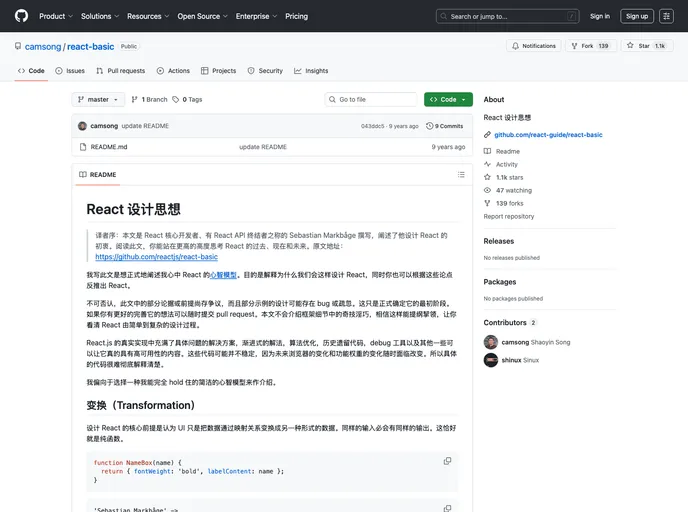
React 设计思想
Overview
React has revolutionized the way we think about user interface development, channeling a mindset that balances simplicity and complexity. Written by Sebastian Markbåge, a core developer of React, the document captures the essence of React's design philosophy. By emphasizing concepts like transformation, abstraction, and composition, Markbåge offers a vantage point to understand the evolution of React, its current implications, and its potential future.
The insights presented not only illuminate the design intentions behind React but also encourage developers to engage with its principles. From managing UI state to optimizing performance through memoization, the text provides a thorough exploration of key ideas, fostering a richer understanding of React’s capabilities.
Features
-
Transformation: React envisions UI as a transformation that maps data to its visual representation, promoting the concept of pure functions where the same input always yields the same output.
-
Abstraction: Complex UIs can't be achieved with a single function; they must be broken down into smaller, reusable functions to manage hidden internal details effectively.
-
Composition: Achieving true reusability requires combining different abstractions rather than merely reusing the simplest components, leading to more robust and flexible UIs.
-
State Management: React recognizes that UI is not just a copy of server-side states but includes various states specific to rendering needs, advocating for an immutable data model to streamline updates.
-
Memoization: To enhance performance, React introduces memoization techniques that track parameters and results, preventing redundant function executions when the same values are used.
-
List Management: Managing UI elements often involves displaying lists, where maintaining each item's state effectively is crucial, highlighting the importance of data structures like Maps.
-
Continuations: React minimizes repetitive boilerplate code by strategically delaying function executions, allowing for cleaner business logic through techniques like currying.
-
Context: React's context mechanism simplifies data sharing across multiple layers of abstraction without cumbersome parameter passing, streamlining component communication.