
Angular Form For
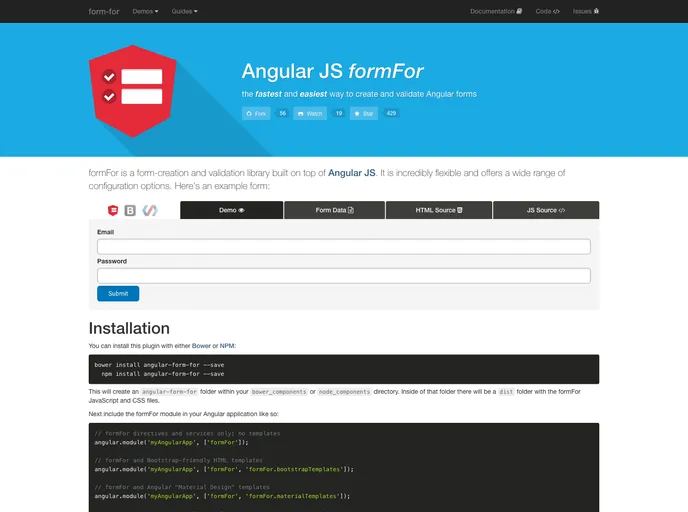


Set of Angular directives to simplify creating and validating HTML forms.
Overview
Exploring ways to streamline form management in Angular applications can often lead to a search for efficient solutions. Angular-form-for presents itself as a powerful tool for developers looking to simplify the creation of complex HTML forms. Despite its discontinuation in active maintenance, the features it offers make it a noteworthy consideration for those working with Angular, especially when it comes to forms requiring both client and server-side validations.
This library proves to be a handy option, allowing for quick form generation with minimal markup. Its flexibility and compatibility with Angular make it a viable choice for developers who appreciate simplicity without sacrificing functionality.
Features
-
Easy Form Declaration: Quickly create complex HTML forms with minimal markup, improving development speed and efficiency.
-
Client and Server-Side Validations: Built-in validation capabilities ensure that forms meet both client and server requirements, enhancing data integrity.
-
No Third-Party Dependencies: Operates independently without the need for external libraries like jQuery, lodash, or underscore, keeping your project lightweight.
-
Bootstrap Compatibility: Designed to work seamlessly with Bootstrap 3.2.x, providing a consistent look and feel for your forms.
-
Flexible Configuration Options: Offers a variety of configuration settings, allowing developers to customize forms according to specific needs.
-
Lightweight Installation: Simple installation process via Bower or NPM, placing essential files directly in your project's components directory.
-
No Maintenance Burden: Although the library is no longer actively maintained, it can still serve as a reliable tool for projects that do not require the latest updates.
- Angular
Angular is a TypeScript-based open-source framework by Google for building dynamic single-page applications and cross-platform mobile apps with MVC architecture and a rich set of features.
- Bootstrap
Bootstrap is the most popular CSS Framework for developing responsive and mobile-first websites.
- Gulp

Gulp.js is an old but popular site building tool that automates various repetitive development tasks in web development, such as compiling Sass, minifying JavaScript, and optimizing images.