
Chakra Multiselect
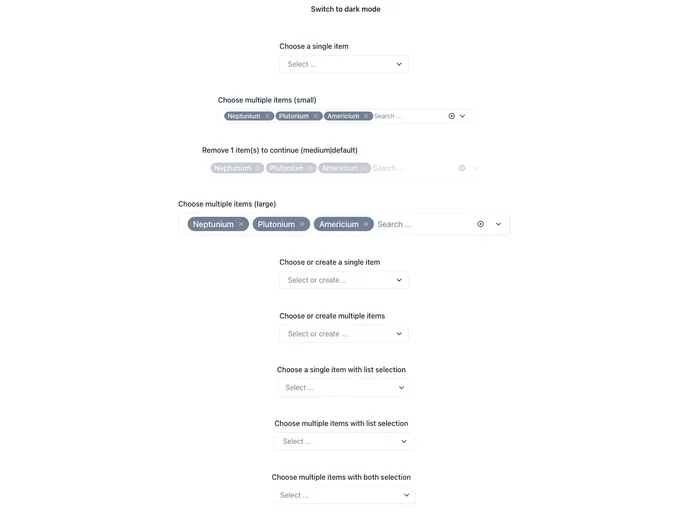


A ChakraUI infused Multiselect component
Overview
The chakra-multiselect component is a versatile tool designed to enhance your application's user interface by providing an elegant and customizable multiselect dropdown. Built using Chakra UI, it seamlessly integrates into React applications, allowing users to select multiple options with ease. The component is perfect for scenarios where users need to make multiple choices, such as selecting items from a list or filtering results based on specific criteria.
What sets chakra-multiselect apart is not only its functionality but also its flexibility. With options for different modes, it can adapt to various use cases, making it a valuable addition to any developer's toolkit.
Features
- Single Mode: Users can select one option from a list, streamlining the selection process for straightforward scenarios.
- Multi Mode: Allows for the selection of multiple options, making it ideal for more complex choices where numerous selections are required.
- Single + Create Mode: This mode empowers users to both select an existing option and create a new one, adding significant versatility.
- Multi + Create Mode: Combines the functionality of multiple selections with the ability to create new options, offering users maximum flexibility.
- ChakraProvider Integration: Easily implementable by wrapping your application with ChakraProvider, ensuring design consistency across your app.
- Custom Theming: The component supports customizable themes, allowing for easy integration with your application's design language.
- Supportive Documentation: Comprehensive documentation is available to guide users through installation and usage, ensuring a smooth development experience.
- MIT License: The component is open source under the MIT License, promoting usage and contribution from the developer community.
- React
React is a widely used JavaScript library for building user interfaces and single-page applications. It follows a component-based architecture and uses a virtual DOM to efficiently update and render UI components
- Chakra UI
Chakra UI is a popular open-source React component library that provides a set of accessible and customizable UI components to help developers create modern web applications.
- Eslint

ESLint is a linter for JavaScript that analyzes code to detect and report on potential problems and errors, as well as enforce consistent code style and best practices, helping developers to write cleaner, more maintainable code.
- Framer Motion

Alpine.js is a lightweight JavaScript framework that simplifies the process of creating dynamic, reactive user interfaces on the web. It uses a declarative syntax that offers a higher level of abstraction compared to vanilla JavaScript, while being more performant and easier to use than jQuery.
- GitHub Pages

Gridsome is a Vue.js-based static site generator that makes it easy to build fast and flexible websites and applications by leveraging modern web technologies like GraphQL, Webpack, and hot reloading
- Typescript

TypeScript is a superset of JavaScript, providing optional static typing, classes, interfaces, and other features that help developers write more maintainable and scalable code. TypeScript's static typing system can catch errors at compile-time, making it easier to build and maintain large applications.