
Docs Template
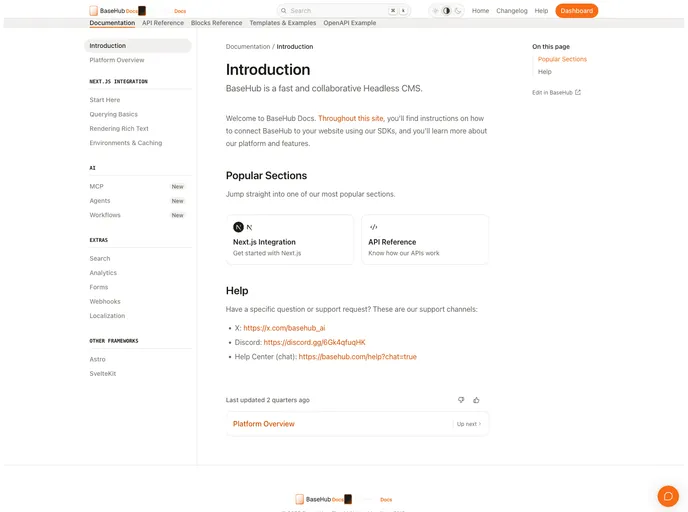



Fully featured documentation website, powered by Next.js, Radix Themes, and BaseHub.
Overview
BaseHub Templates are a fantastic solution for anyone looking to quickly create a professional online presence. Designed particularly for documentation websites, these templates are ready to go right out of the box, making it easy for developers and users alike to share vital information seamlessly. With its robust features and user-friendly interface, BaseHub simplifies the process of documentation creation while offering a range of customization options to suit your needs.
The versatility of BaseHub Templates means you can easily adapt them for various uses, from user manuals to developer documentation. The combination of essential functionalities and a simple setup process ensures that even those with limited technical skills can effectively launch their websites in no time.
Features
-
Fully Featured Documentation Website: Perfect for creating professional documentation for developers, users, and various project guides.
-
Editable from BaseHub: Modify content easily directly from the BaseHub platform to keep your documentation up to date.
-
Search Functionality: Built-in search capabilities allow users to find information quickly, enhancing usability and efficiency.
-
Dark/Light Mode: With options for both dark and light themes, users can choose their preferred viewing experience.
-
Analytics Integration: Monitor your website's performance and user engagement through integrated analytics, allowing for data-driven improvements.
-
One Click Deployment: Seamless deployment with Vercel means you can launch your site to the web effortlessly, saving time and effort.
-
Local Development Support: Setting up a local development environment is a breeze, enabling you to test changes before going live.
-
Easy Setup Requirements: All you need is a BaseHub account and a deployment platform; no need for additional services.
- Next.js
Next.js is a React-based web framework that enables server-side rendering, static site generation, and other powerful features for building modern web applications.
- React
React is a widely used JavaScript library for building user interfaces and single-page applications. It follows a component-based architecture and uses a virtual DOM to efficiently update and render UI components
- SCSS
SCSS is a preprocessor scripting language that extends the capabilities of CSS by adding features such as variables, nesting, and mixins. It allows developers to write more efficient and maintainable CSS code, and helps to streamline the development process by reducing repetition and increasing reusability.
- Geist UI
Geist UI is a modern, minimalist React component library inspired by Vercel's design language. It provides clean, elegant components with a focus on simplicity and developer experience, perfect for building modern web applications.
- Documentation

Documentation themes are built specifically for writing technical and product documentation. They are normally written and maintained in Markdown. The often include a navigation menu, search bar, clear headings, semantic document structure and clean typography.
- Eslint

ESLint is a linter for JavaScript that analyzes code to detect and report on potential problems and errors, as well as enforce consistent code style and best practices, helping developers to write cleaner, more maintainable code.
- Postcss

PostCSS is a popular open-source tool that enables web developers to transform CSS styles with JavaScript plugins. It allows for efficient processing of CSS styles, from applying vendor prefixes to improving browser compatibility, ultimately resulting in cleaner, faster, and more maintainable code.
- Typescript

TypeScript is a superset of JavaScript, providing optional static typing, classes, interfaces, and other features that help developers write more maintainable and scalable code. TypeScript's static typing system can catch errors at compile-time, making it easier to build and maintain large applications.