
Nextjs_vps
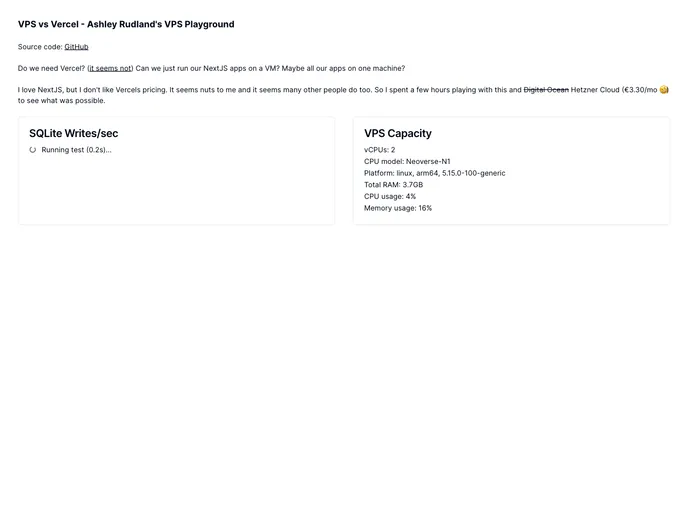



NextJS VPS Example
Overview
Exploring alternatives to Vercel for deploying Next.js applications can be an intriguing venture, particularly for indie hackers seeking cost-effective solutions. Many developers find Vercel's pricing structure to be on the higher side, leading them to seek out viable hosting options on virtual machines (VMs). This review highlights the potential of using cloud providers like Hetzner, which offers an incredibly affordable pricing tier.
Through various tests, it seems that running Next.js on a VPS can meet the essential performance and feature requirements needed for most applications. With minimal latency and a straightforward deployment process facilitated by GitHub Actions, indie developers can maintain their applications efficiently without the hefty price tag.
Features
-
Easy Next.js Deployment: Setting up Next.js on a VPS is straightforward, making it accessible for developers of all skill levels.
-
Low Latency: Achieving around 35ms latency, this setup provides performance similar to Vercel, offering a seamless user experience.
-
Auto Deployment: Utilizing GitHub Actions, the system automatically deploys code changes, enhancing productivity and reducing manual oversight.
-
High Traffic Handling: The Hetzner €3.29/mo VPS handles approximately 750 HTTP requests per second before experiencing slowdowns, making it suitable for moderate traffic levels.
-
SQL Write Performance: Impressively supports 14,000 writes per second using SQLite, driving efficient data management for applications.
-
Reliable Uptime: With a 100% uptime reported so far, this hosting option assures developers of consistent application availability.
-
Next.js Features Supported: Key Next.js features such as image optimization, server actions, and API routes function correctly on this setup, ensuring developers can utilize modern capabilities.
-
Multiple App Hosting: There is potential to run multiple applications on the same machine by switching based on domain names, maximizing resource utilization.
- Next.js
Next.js is a React-based web framework that enables server-side rendering, static site generation, and other powerful features for building modern web applications.
- React
React is a widely used JavaScript library for building user interfaces and single-page applications. It follows a component-based architecture and uses a virtual DOM to efficiently update and render UI components
- Tailwind
Tailwind CSS is a utility-first CSS framework that provides pre-defined classes for building responsive and customizable user interfaces.
- Drizzle ORM
Drizzle ORM is a TypeScript ORM for SQL databases designed with maximum type safety in mind. It comes with a drizzle-kit CLI companion for automatic SQL migrations generation. Drizzle ORM is meant to be a library, not a framework. It stays as an opt-in solution all the time at any levels.
- Eslint

ESLint is a linter for JavaScript that analyzes code to detect and report on potential problems and errors, as well as enforce consistent code style and best practices, helping developers to write cleaner, more maintainable code.
- Postcss

PostCSS is a popular open-source tool that enables web developers to transform CSS styles with JavaScript plugins. It allows for efficient processing of CSS styles, from applying vendor prefixes to improving browser compatibility, ultimately resulting in cleaner, faster, and more maintainable code.
- Recharts

Recharts is a powerful and easy-to-use React library for building customizable and interactive charts. Built on D3.js, it offers a wide range of pre-built chart types, such as line, bar, pie, and scatter charts, all of which can be composed with a declarative syntax.
- Typescript

TypeScript is a superset of JavaScript, providing optional static typing, classes, interfaces, and other features that help developers write more maintainable and scalable code. TypeScript's static typing system can catch errors at compile-time, making it easier to build and maintain large applications.