
Next Colocation Template
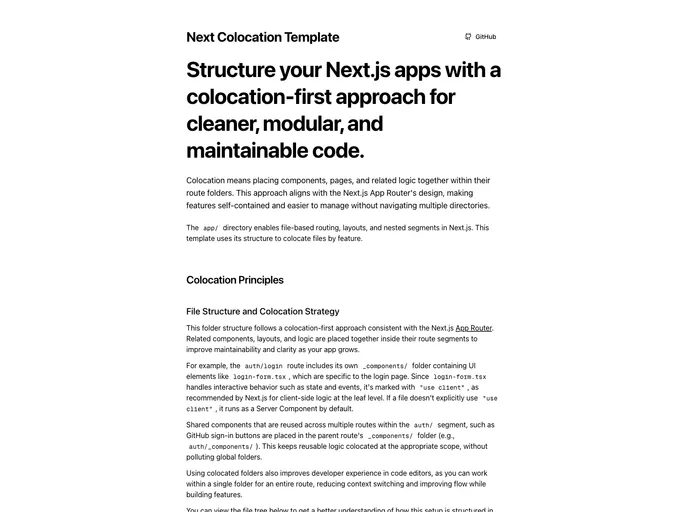


A clean and scalable Next.js template showcasing a colocation-first folder structure with the App Router where pages, components, and logic live together by feature. Built with TypeScript, Tailwind CSS, and Shadcn UI.
Overview
Structuring Next.js applications in a colocation-first approach has proven to be an essential practice for maintaining clean and modular code. By grouping components, pages, and related logic within their respective route folders, developers can keep features self-contained and easier to manage. This method streamlines the development process by aligning with the Next.js App Router's design, allowing for a more efficient workflow as projects grow.
The benefits of this approach extend beyond organization; it enhances the developer experience within code editors by reducing context switching. Developers can focus on one route at a time without navigating through numerous directories, making it easier to build features and maintain clarity.
Features
-
Colocation Strategy: All components and logic related to a specific feature are placed together in their route segments, improving clarity and manageability as applications expand.
-
File-Based Routing: Takes full advantage of Next.js's app directory for seamless file-based routing and nested segments, enabling a logical and intuitive navigation structure.
-
Client-Server Management: Automatically distinguishes between client and server components, improving performance and functionality based on whether a file uses "use client".
-
Private Components Organization: Using the underscore prefix for folders like _components keeps routing logic separate from UI components, enhancing project organization.
-
Developer Experience: Reduces context switching by allowing developers to work within a single folder, making the coding process smoother and more efficient.
-
Reusable Logic Placement: Shared components are colocated at the appropriate scope, preventing pollution of global folders and promoting reuse across multiple routes.
-
Optional Top-Level Routing Groups: Organizes routes without affecting the URL paths, offering flexibility in structuring applications without compromising usability.
-
Starter Project Available: A ready-to-use template that includes essential features like a dashboard and authentication pages, facilitating faster prototyping for new projects.
- Next.js
Next.js is a React-based web framework that enables server-side rendering, static site generation, and other powerful features for building modern web applications.
- React
React is a widely used JavaScript library for building user interfaces and single-page applications. It follows a component-based architecture and uses a virtual DOM to efficiently update and render UI components
- TanStack
TanStack is a collection of high-quality, framework-agnostic libraries including TanStack Query for data fetching, TanStack Router for routing, TanStack Table for tables, and more. These tools provide powerful, type-safe solutions for common web development challenges.
- Tailwind
Tailwind CSS is a utility-first CSS framework that provides pre-defined classes for building responsive and customizable user interfaces.
- cmdk
cmdk is a fast, composable command menu component for React. It provides the foundation for building command palettes, search interfaces, and keyboard-navigable menus similar to those found in applications like VS Code, Linear, and Raycast.
- Radix UI
Radix Primitives is a low-level UI component library with a focus on accessibility, customization and developer experience. You can use these components either as the base layer of your design system, or adopt them incrementally.
- Eslint

ESLint is a linter for JavaScript that analyzes code to detect and report on potential problems and errors, as well as enforce consistent code style and best practices, helping developers to write cleaner, more maintainable code.
- Recharts

Recharts is a powerful and easy-to-use React library for building customizable and interactive charts. Built on D3.js, it offers a wide range of pre-built chart types, such as line, bar, pie, and scatter charts, all of which can be composed with a declarative syntax.
- Typescript

TypeScript is a superset of JavaScript, providing optional static typing, classes, interfaces, and other features that help developers write more maintainable and scalable code. TypeScript's static typing system can catch errors at compile-time, making it easier to build and maintain large applications.
- React Hook Form

React Hook Form is a performant, flexible, and extensible form library for React with easy validation. It reduces re-renders and improves performance by using uncontrolled components and native HTML validation, making form handling simple and efficient.
- Zod

Zod is a TypeScript-first schema declaration and validation library. It allows you to define schemas that can validate data at runtime while providing excellent TypeScript inference, making it perfect for API validation, form validation, and type-safe data handling.