
Django Dbbackup
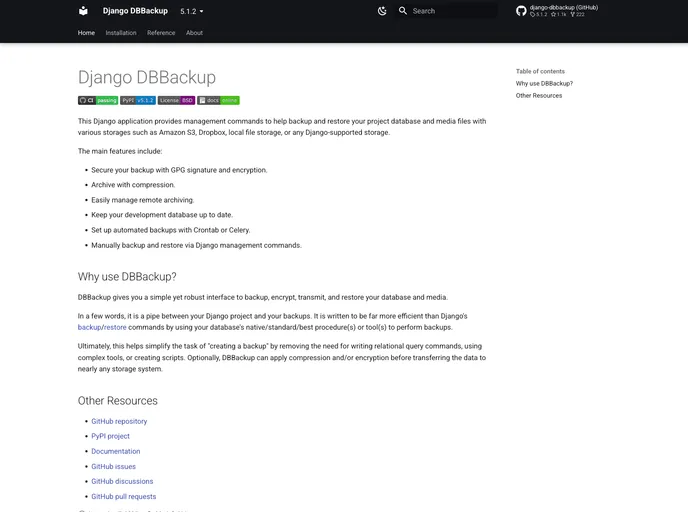

Backup and restore your Django database and media
Overview
Django DBBackup is a powerful solution for managing backups of your project database and media files, designed specifically for Django applications. It streamlines the process of securing and restoring your data through an easy-to-use interface, allowing you to connect with various storage options such as Amazon S3, Dropbox, and local file storage. With a focus on efficiency and simplicity, DBBackup is an essential tool for ensuring your data is safe and easily recoverable.
This application not only offers a structured approach to backups but also incorporates robust security measures. Its features make it an excellent choice for developers who need a reliable way to maintain their databases without navigating the complexities of traditional backup methods. By reducing the hassle of backup management, Django DBBackup allows developers to focus on what they do best: building great applications.
Features
-
GPG Signature and Encryption: Secure your backups effectively with built-in encryption and signatures to protect your data from unauthorized access.
-
Compression: Archive your backups with compression to save storage space and make data transfers faster.
-
Remote Archiving Management: Easily manage archiving to remote locations, ensuring your backups are stored safely in your preferred storage system.
-
Development Database Synchronization: Keep your development database up to date with the latest backups, minimizing discrepancies between your development and production environments.
-
Automated Backups: Set up automated backup schedules using Crontab or Celery for seamless and routine data protection.
-
Manual Backup and Restore Commands: Easily perform manual backups and restores via Django management commands, giving you flexibility when needed.
Django DBBackup is an indispensable tool for any Django developer looking to enhance their data management practices with security and efficiency.
- Django
Django is a high-level Python web framework that encourages rapid development and clean, pragmatic design. It follows the model-view-controller (MVC) architectural pattern, providing an extensive set of built-in tools and conventions to streamline the creation of robust and scalable web applications.