
Web Components Angular React
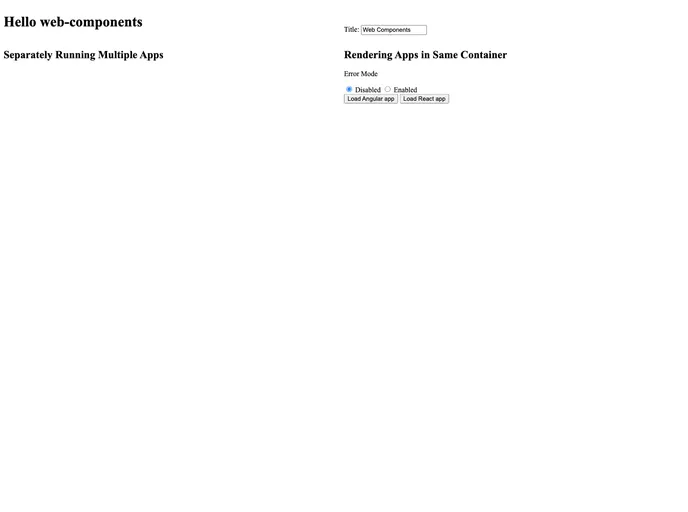


Multiple apps as components POC
Overview
The integration of Angular and React through web components presents an exciting opportunity for developers to utilize the strengths of both frameworks. This collaboration allows for the creation of dynamic, reusable elements that can be shared across various applications. The approach aims to enhance the efficiency of application development while also improving maintainability.
One interesting feature of this setup is the built-in error handling mechanism. Each application has a 50% chance of failure, which is intentionally designed. This randomness serves as a practical demonstration of how errors can be effectively managed and communicated within the container, showcasing the robustness of the architecture.
Features
-
Seamless Integration: Easily combine Angular and React components, allowing developers to leverage the best features of both frameworks.
-
Reusable Components: Create modular components that can be used across different applications, enhancing code reusability and efficiency.
-
Dynamic Error Handling: Each application simulates random failures to illustrate error management, providing insight into how to gracefully handle issues in production.
-
Real-time Demonstration: The 50% failure rate offers a practical way to understand the error lifecycle and how it can be communicated to the user interface.
-
Container-based Architecture: Centralizes the management of various components, improving organization and scalability in application design.
- Angular
Angular is a TypeScript-based open-source framework by Google for building dynamic single-page applications and cross-platform mobile apps with MVC architecture and a rich set of features.
- React
React is a widely used JavaScript library for building user interfaces and single-page applications. It follows a component-based architecture and uses a virtual DOM to efficiently update and render UI components
- Webpack

Webpack is a popular open-source module bundler for JavaScript applications that bundles and optimizes the code and its dependencies for production-ready deployment. It can also be used to transform other types of assets such as CSS, images, and fonts.