
Gruid
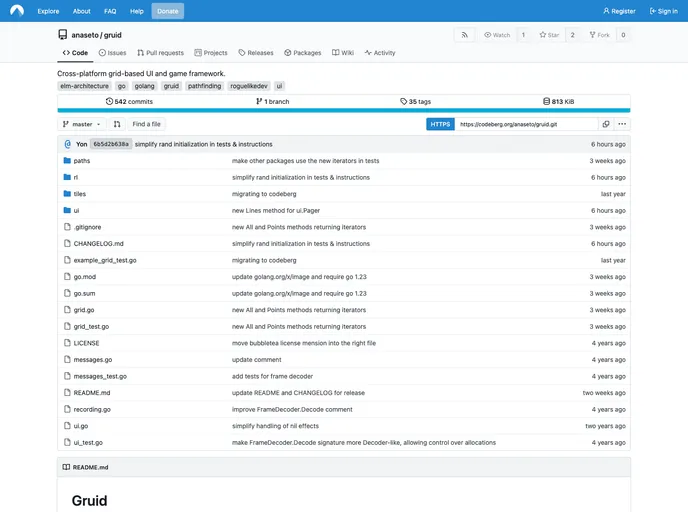
Cross-platform grid-based UI and game framework.
Overview
Gruid is an innovative library designed for building grid-based applications in Go, showcasing a versatile approach to rendering and input across various platforms. With its foundation in grid-based game development, Gruid extends its capabilities to a broader range of applications, providing an efficient and flexible architecture that adapts Go's idiomatic practices while drawing inspiration from the functional Elm Architecture.
Whether you're looking to create terminal applications, native graphical interfaces, or browser-based games, Gruid offers a powerful framework that simplifies the development process. Its modular design not only streamlines code but also enhances performance, making it a solid choice for developers seeking to implement grid-based solutions effectively.
Features
-
Multiple Platform Support: Gruid supports terminal, graphical, and web applications through its dedicated drivers:
gruid-tcell,gruid-sdl, andgruid-js. -
Efficient Model and Driver Interfaces: The library defines core interfaces that facilitate the main loop of applications, implementing an efficient architecture for state management.
-
Intuitive UI Widgets: The
uipackage includes a variety of common widgets like menus, tables, and text inputs, simplifying UI development for grid applications. -
Font and Image Handling: The
tilespackage provides tools for drawing fonts on images, essential for creating character tiles and enhancing visual presentation. -
Advanced Pathfinding Algorithms: With implementations of popular algorithms like A*, JPS, and Dijkstra, the
pathspackage is perfect for developing grid-based games requiring navigation mechanics. -
Game-Specific Utilities: The
rlpackage offers essential tools for roguelike game development, including event queuing, field of view algorithms, and map generation utilities. -
Comprehensive Examples: Gruid is accompanied by an
examplesmodule, showcasing practical use cases and annotated examples to help developers get started quickly. -
User-friendly Documentation: Detailed documentation provides an overview of all packages and functionalities, ensuring a smooth learning curve for new users.