
React Openlayers
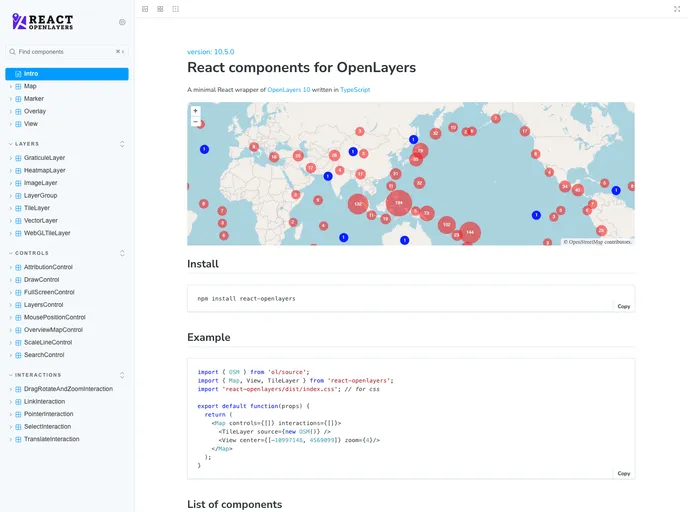


OpenLayer React Components
Overview
The React components for OpenLayers provide a streamlined approach for developers looking to integrate robust mapping functionalities into their applications. Built with TypeScript, this minimal wrapper allows for seamless interaction with OpenLayers 10, making it easier to manage complex mapping tasks through a familiar React interface. Whether you're building a simple map or a comprehensive geospatial application, these components cater to a wide range of needs while enhancing performance and usability.
The collection includes essential components that allow developers to manipulate maps effectively, display various data layers, and implement interactive controls. With a variety of features and interactions, it promises to simplify the process of embedding dynamic maps into React applications, enabling quick and straightforward developments.
Features
-
<Map />: Central to the application, it manages layers, controls, and interactions, providing an overall rendering of the map.
-
<Overlay />: This component enables the addition of HTML elements to the map at specific coordinates, enhancing user interface customizations.
-
<View />: Represents a simple 2D view of the map, allowing developers to easily control the user's perspective.
-
<Marker />: A customized feature component specifically designed for placing markers on the map for visual representation.
-
<GraticuleLayer />: Displays a grid of latitude and longitude lines, providing essential reference points on the map.
-
<HeatmapLayer />: Visualizes data through a heatmap generated from vector data, helping in data analysis and representation.
-
<VectorLayer />: Supports the display of vector data, including points, lines, and polygons, making data visualization versatile.
-
<AttributionControl />: Shows attribution information for the map layers, ensuring users are aware of the data sources and licensing.
These features collectively enhance the mapping experience, making it more interactive and user-friendly while leveraging the capabilities of React and OpenLayers.
- React
React is a widely used JavaScript library for building user interfaces and single-page applications. It follows a component-based architecture and uses a virtual DOM to efficiently update and render UI components
- Vite
Vite is a build tool that aims to provide a faster and leaner development experience for modern web projects
- Eslint

ESLint is a linter for JavaScript that analyzes code to detect and report on potential problems and errors, as well as enforce consistent code style and best practices, helping developers to write cleaner, more maintainable code.
- Storybook
Storybook is a tool for developing and testing UI components in isolation. It provides a sandbox environment where you can experiment with different props and states to see how your component responds.
- Typescript

TypeScript is a superset of JavaScript, providing optional static typing, classes, interfaces, and other features that help developers write more maintainable and scalable code. TypeScript's static typing system can catch errors at compile-time, making it easier to build and maintain large applications.