
Kuma Mieru
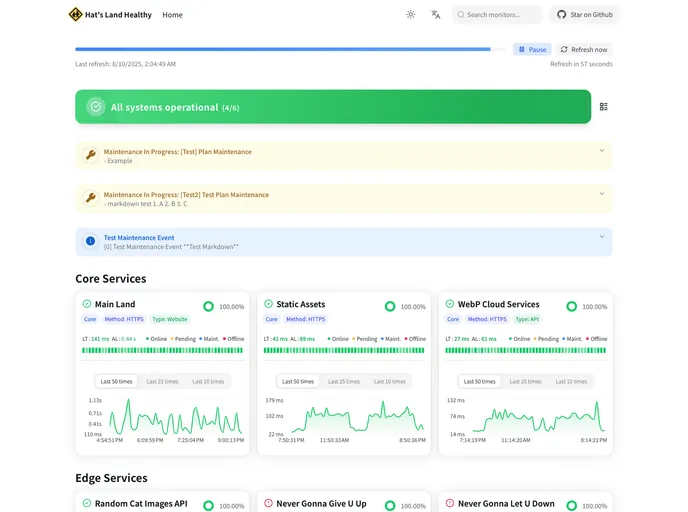


A 3rd-party Uptime Kuma monitoring dashboard built on Next.js 16, TypeScript and Recharts.
Overview
Kuma Mieru is an advanced third-party monitoring dashboard for Uptime Kuma, built on Next.js 15, TypeScript, and Recharts. It addresses several shortcomings of Uptime Kuma’s built-in public status page, particularly by enhancing data visualization with dynamic delay charts and a more intuitive interface. This dashboard allows users to monitor their site’s uptime effectively, providing a sleek and responsive design that adapts to various screen sizes.
The core strength of Kuma Mieru lies in its real-time monitoring capabilities and user-friendly features. Developers and site administrators can set it up quickly, making it a great addition for anyone relying on Uptime Kuma for monitoring services.
Features
-
Real-Time Monitoring: Automatically refreshes to display the latest status updates without manual intervention, ensuring users are always informed about their services.
-
Beautiful Responsive Interface: Built with HeroUI components, the dashboard boasts a modern look that is fully responsive, providing a seamless experience across devices.
-
Interactive Charts: Utilizes Recharts for data visualization, allowing users to interactively explore latency, status, and other essential metrics of various nodes.
-
Multi-Theme Support: Offers dark, light, and system themes to cater to different user preferences, enhancing personal usability.
-
Maintenance Announcements: Supports the updating of event notifications and status changes from Uptime Kuma, ensuring that all relevant information is synchronized effectively.
-
Quick Deployment Options: Users can easily deploy the dashboard using platforms like Vercel or through Docker, simplifying the setup process.
-
Environment Variable Configuration: Easy configuration through environment variables, ensuring sensitive data remains secure while allowing customization of monitoring parameters.
- Next.js
Next.js is a React-based web framework that enables server-side rendering, static site generation, and other powerful features for building modern web applications.
- React
React is a widely used JavaScript library for building user interfaces and single-page applications. It follows a component-based architecture and uses a virtual DOM to efficiently update and render UI components
- Tailwind
Tailwind CSS is a utility-first CSS framework that provides pre-defined classes for building responsive and customizable user interfaces.
- Framer Motion

Alpine.js is a lightweight JavaScript framework that simplifies the process of creating dynamic, reactive user interfaces on the web. It uses a declarative syntax that offers a higher level of abstraction compared to vanilla JavaScript, while being more performant and easier to use than jQuery.
- MDX

MDX is a format that allows developers to write JSX within Markdown documents, combining the power of React with the simplicity of Markdown. This allows for the creation of dynamic and interactive content that can be easily shared and consumed across different platforms and devices.
- Postcss

PostCSS is a popular open-source tool that enables web developers to transform CSS styles with JavaScript plugins. It allows for efficient processing of CSS styles, from applying vendor prefixes to improving browser compatibility, ultimately resulting in cleaner, faster, and more maintainable code.
- Recharts

Recharts is a powerful and easy-to-use React library for building customizable and interactive charts. Built on D3.js, it offers a wide range of pre-built chart types, such as line, bar, pie, and scatter charts, all of which can be composed with a declarative syntax.
- Typescript

TypeScript is a superset of JavaScript, providing optional static typing, classes, interfaces, and other features that help developers write more maintainable and scalable code. TypeScript's static typing system can catch errors at compile-time, making it easier to build and maintain large applications.
- Zod

Zod is a TypeScript-first schema declaration and validation library. It allows you to define schemas that can validate data at runtime while providing excellent TypeScript inference, making it perfect for API validation, form validation, and type-safe data handling.