
Google Maps

Collection of Google Maps API Web Services for Laravel
Overview
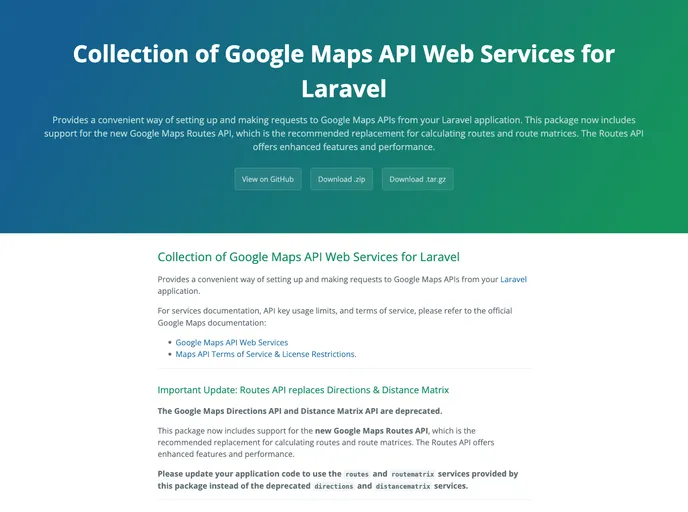
The Collection of Google Maps API Web Services for Laravel simplifies the integration of Google Maps functionalities into Laravel applications. This package makes it incredibly easy for developers to set up and make requests to various Google Maps APIs, leveraging their extensive services right from the Laravel framework. With recent updates, the package now includes support for the new Routes API, replacing the deprecated Directions and Distance Matrix APIs, thereby enhancing performance and providing developers with modern solutions for route calculations.
This package not only streamlines the process of implementing mapping services, but it also allows for a more efficient configuration by letting users specify different API keys for various services. As developers continue to adapt to changes in API recommendations, this package stands out as a reliable tool that caters to their needs.
Features
-
Routes API: The recommended replacement for the deprecated Directions & Distance Matrix APIs, enabling users to compute accurate routes between locations.
-
Route Matrix: Compute route matrices efficiently for multiple origins and destinations, ensuring quick and effective route planning.
-
Elevation API: Retrieve elevation data for specified locations, allowing for enhanced geographical analysis in applications.
-
Geocoding API: Converts addresses into geographic coordinates, making it easier to plot locations on a map.
-
Geolocation API: Provides the physical location of users, improving user experience in location-based services.
-
Roads API: Identifies the road segments a user’s coordinates belong to, adding accuracy to routing.
-
Time Zone API: Fetches time zone information for specific locations, handy for applications that work across different regions.
-
Places API: Access to various place-related functionalities, with support for enhanced features allowing developers to create more interactive applications.
- Laravel
Laravel is a powerful and elegant PHP framework that provides developers with a comprehensive set of tools and features to build robust web applications. It follows the Model-View-Controller (MVC) architectural pattern, offering a clean and organized structure for writing efficient and maintainable code.