
Nimpl I18n
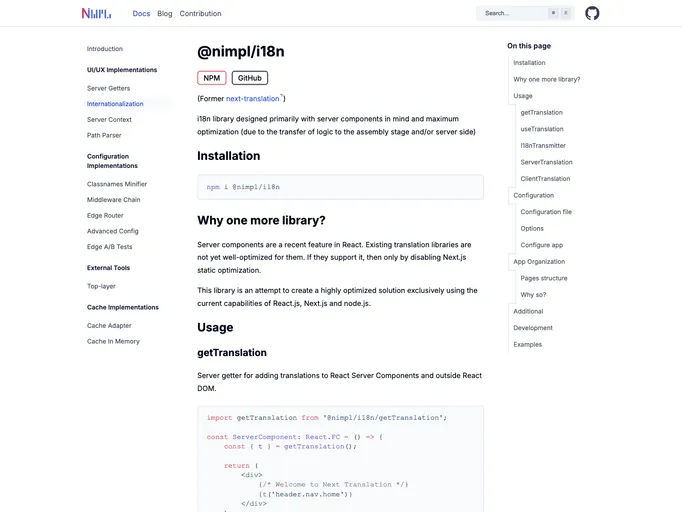


Internationalization library for React.js with an enabled server component (especially for Next.js App Router).
Overview
The @nimpl/i18n library emerges as a compelling solution for developers utilizing server components in React, particularly in conjunction with Next.js and Node.js. As server components become a more integral part of the React ecosystem, conventional translation libraries often fail to optimize fully for this dynamic. This library aims to harness the new potential of these technologies, providing a seamless, efficient way to manage translations without compromising on performance.
What sets @nimpl/i18n apart is its focus on real-time, up-to-date translations through innovative server-side logic. By transferring the heavy lifting to the assembly stage or the server, the library ensures that translations remain relevant, optimizing the user experience as well as the performance of the application.
Features
-
Real-time Translation Loading: Load translations during page rendering, ensuring users always get the latest content via ISR or SSR.
-
Revalidation Logic: Specify the frequency at which translations need to be updated, or opt for no automatic updates at all for greater control.
-
Optimized Caching System: Avoid unnecessary requests with a caching system that ensures efficiency even during parallel building.
-
Selective Translation Delivery: Only the translations required on the client are passed through, reducing overhead and improving load times.
-
Server-side Parameter Embedding: Instantiate parameters directly in translations on the server, streamlining client-side rendering.
-
HTML Entity Support: Easily manage HTML entities within translations, ensuring proper rendering across different contexts.
With its innovative approach and robust feature set, @nimpl/i18n is a significant advancement in managing translations for React applications employing server components, making it a must-try for developers.
- Next.js
Next.js is a React-based web framework that enables server-side rendering, static site generation, and other powerful features for building modern web applications.
- React
React is a widely used JavaScript library for building user interfaces and single-page applications. It follows a component-based architecture and uses a virtual DOM to efficiently update and render UI components
- Eslint

ESLint is a linter for JavaScript that analyzes code to detect and report on potential problems and errors, as well as enforce consistent code style and best practices, helping developers to write cleaner, more maintainable code.