
Boilerplate
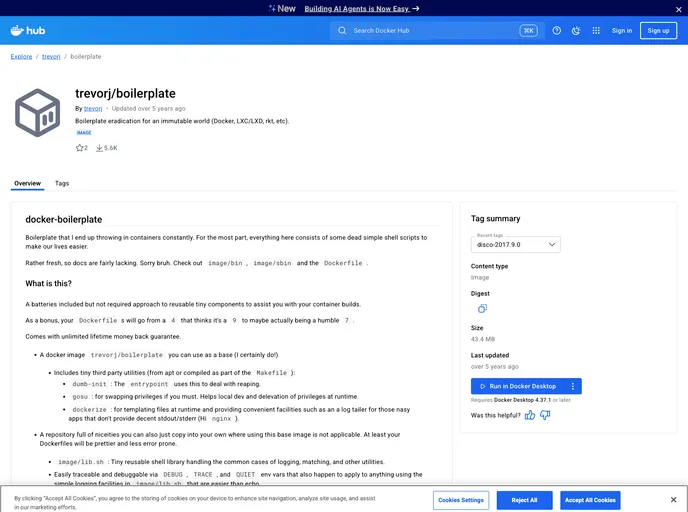
Boilerplate eradication for an immutable world (Docker, LXC/LXD, rkt, etc).
Overview
The docker-boilerplate is a powerful tool designed to simplify the process of building Docker containers. Leveraging a collection of straightforward shell scripts, it streamlines the setup of your containers, providing a base that enhances both functionality and usability. This boilerplate is particularly appealing to developers who are looking for a handy, preconfigured starting point without the need for endless customization.
One of the standout aspects of this boilerplate is its focus on convenience and efficiency, transforming your Dockerfiles from basic to more sophisticated setups with ease. While the documentation may be in its early stages, the built-in components and utilities contribute to a seamless development experience that saves time and minimizes errors in your container configurations.
Features
-
Prebuilt Docker Image: Comes with a ready-to-use Docker image (
trevorj/boilerplate) that can be utilized as a foundation for your own projects. -
Essential Utilities: Includes small third-party utilities such as
dumb-init,gosu, anddockerize, which enhance functionality and make local development smoother. -
Reusable Shell Library: Offers a tiny shell library (
image/lib.sh) for common tasks like logging and matching, simplifying your scripts. -
Intuitive Structure: Organizes your application with a clear layout —
/appfor app files and/imagefor image utilities, making it easy to navigate. -
Customizable Entry Points: Features a hookable entrypoint that allows for easy customization without the frustration typically associated with Docker images.
-
Efficient Package Management: The
lazy-aptfunctionality manages package installations efficiently, cleaning up automatically after installations to keep the image lean. -
Consistent Environment Variables: Ensures no hard-coded values by using environment variables for configuration, allowing for flexibility across different setups.
-
Debugging-Friendly: Equipped with debugging options (
DEBUG,TRACE,QUIET), making it easier to track down issues within your Docker setup.
- Docker

A website that uses Docker for containerization to streamline development, testing, and deployment workflows. This includes features such as containerization of dependencies, automated builds and deployments, and container orchestration to ensure scalability and availability.