
Lume
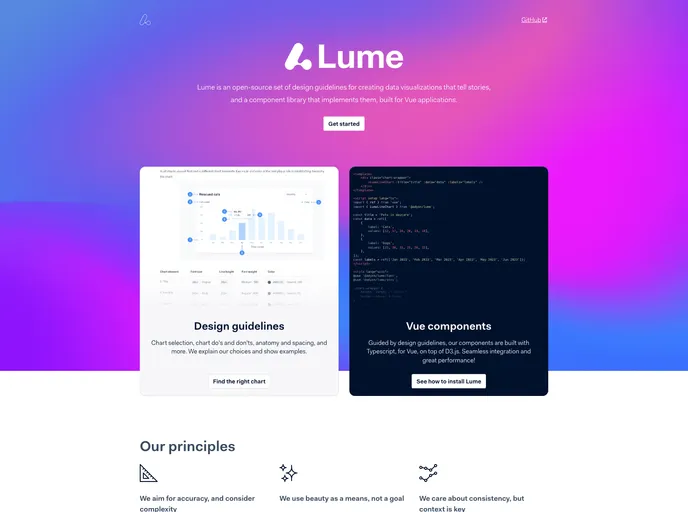


Lume is a component library for visual representations of data, built for Vue with D3.
Overview
Lume is an innovative library specifically designed for creating compelling data visualizations within Vue applications. It combines a comprehensive set of design guidelines with an extensive component library, aiming to simplify the process of integrating rich visual storytelling into web applications. By supporting both Vue 2.7 and Vue 3, Lume caters to a wide range of developers while showcasing a commitment to robust data visualization principles.
The library stands out due to its focus on reactivity and SVG rendering, allowing developers to create dynamic and engaging graphics effortlessly. Its straightforward installation and development process further enhance its appeal, making it an excellent choice for anyone looking to elevate their data visualization game.
Features
-
Dual Vue Support: Lume ships in two distinct packages—one tailored for Vue 2.7 and another for Vue 3—ensuring compatibility and ease of use across different projects.
-
Robust Design Principles: Built on strong data visualization guidelines and patterns, Lume helps developers create visually attractive and informative displays of data.
-
SVG Rendering: Utilizes Vue's capabilities for rendering scalable vector graphics, which is essential for high-quality visualizations that remain crisp at any size.
-
Comprehensive Component Library: Offers a variety of pre-built components such as bar charts and diagrams, simplifying the process of adding complex visuals to any application.
-
Developer Tools Integration: Incorporates modern development tools like Storybook for component showcasing and testing, allowing for efficient development workflows.
-
Responsive Tooltips: Integrates Popper.js for tooltip functionality, enhancing user interaction with visual elements.
-
Extensive Testing Framework: Supports Vitest for unit testing, ensuring the reliability and functionality of components before deployment.
-
Flexible Styling Options: Allows developers to import styles through CSS and Sass, providing comprehensive customization to meet design needs.
- Vue
Vue.js is a lightweight and flexible JavaScript framework that allows developers to easily build dynamic and reactive user interfaces. Its intuitive syntax, modular architecture, and focus on performance make it a popular choice for modern web development.
- SCSS
SCSS is a preprocessor scripting language that extends the capabilities of CSS by adding features such as variables, nesting, and mixins. It allows developers to write more efficient and maintainable CSS code, and helps to streamline the development process by reducing repetition and increasing reusability.
- Eslint

ESLint is a linter for JavaScript that analyzes code to detect and report on potential problems and errors, as well as enforce consistent code style and best practices, helping developers to write cleaner, more maintainable code.
- Typescript

TypeScript is a superset of JavaScript, providing optional static typing, classes, interfaces, and other features that help developers write more maintainable and scalable code. TypeScript's static typing system can catch errors at compile-time, making it easier to build and maintain large applications.
- Webpack

Webpack is a popular open-source module bundler for JavaScript applications that bundles and optimizes the code and its dependencies for production-ready deployment. It can also be used to transform other types of assets such as CSS, images, and fonts.