
Github Readme Tech Stack
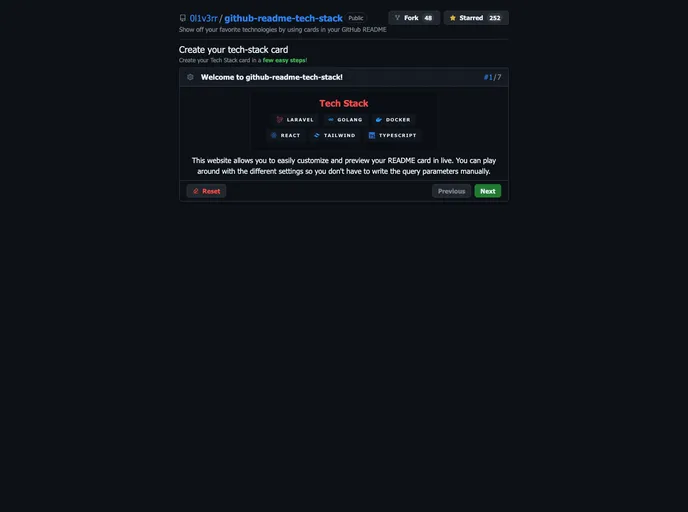


Show off your favorite technologies by using cards in your GitHub README
Overview
As a developer, having a polished and visually appealing way to present your skills is crucial, and the github-readme-tech-stack tool delivers just that. It allows you to create customized visual representations of the technologies you use in your GitHub projects, showcasing your expertise in a way that catches the eye of potential collaborators and employers. In an era where standing out is more important than ever, this solution fits seamlessly into the growing trend of personalized branding within the tech community.
The simplicity of usage combined with its customization capabilities makes it an enticing option for anyone looking to enhance their GitHub profile. Gone are the days of generic badges that clash with your carefully curated profile; with github-readme-tech-stack, you can create a cohesive look that reflects your personal branding and style, ensuring that your tech stack shines.
Features
- Easy to use: Simply add a markdown tag to your profile README to create your Tech Stack image with minimal effort.
- Demo website: The tool offers a live demo site where you can effortlessly design and build your own custom card.
- Customizable: Select the technologies to showcase, adjust colors, and modify icons to fit your personal brand perfectly.
- Custom icons: Upload your own SVG icons to represent technologies that may not be included by default.
- Multiple themes: Choose from several pre-made themes or create your own if none fit your aesthetic.
- Badges: Utilizes shields.io badges and simple-icons to enhance the visual appeal and credibility of your tech stack.
- Style: Designed harmoniously to match with tools like github-readme-streak-stats and github-readme-stats, ensuring a consistent look across your profile.
- Next.js
Next.js is a React-based web framework that enables server-side rendering, static site generation, and other powerful features for building modern web applications.
- React
React is a widely used JavaScript library for building user interfaces and single-page applications. It follows a component-based architecture and uses a virtual DOM to efficiently update and render UI components
- Tailwind
Tailwind CSS is a utility-first CSS framework that provides pre-defined classes for building responsive and customizable user interfaces.
- Eslint

ESLint is a linter for JavaScript that analyzes code to detect and report on potential problems and errors, as well as enforce consistent code style and best practices, helping developers to write cleaner, more maintainable code.
- Postcss

PostCSS is a popular open-source tool that enables web developers to transform CSS styles with JavaScript plugins. It allows for efficient processing of CSS styles, from applying vendor prefixes to improving browser compatibility, ultimately resulting in cleaner, faster, and more maintainable code.
- Storybook
Storybook is a tool for developing and testing UI components in isolation. It provides a sandbox environment where you can experiment with different props and states to see how your component responds.
- Typescript

TypeScript is a superset of JavaScript, providing optional static typing, classes, interfaces, and other features that help developers write more maintainable and scalable code. TypeScript's static typing system can catch errors at compile-time, making it easier to build and maintain large applications.
- Webpack

Webpack is a popular open-source module bundler for JavaScript applications that bundles and optimizes the code and its dependencies for production-ready deployment. It can also be used to transform other types of assets such as CSS, images, and fonts.
- Zod

Zod is a TypeScript-first schema declaration and validation library. It allows you to define schemas that can validate data at runtime while providing excellent TypeScript inference, making it perfect for API validation, form validation, and type-safe data handling.