Sagarshah.dev
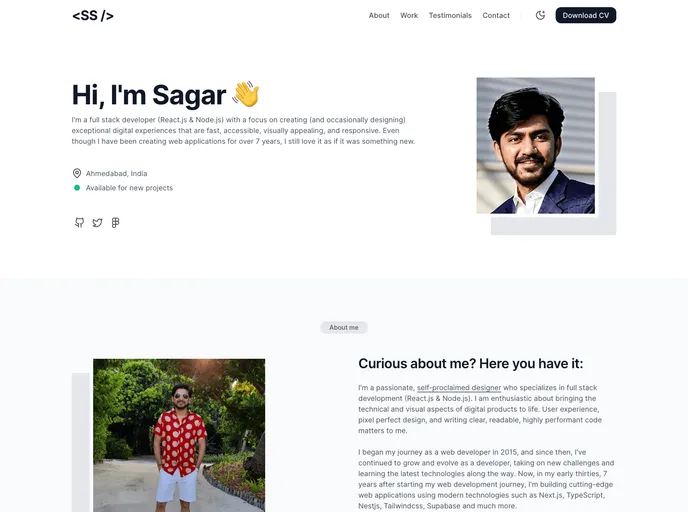



My portfolio website built with Next.js, Tailwind CSS, Radix UI and deployed on Vercel.
Overview
If you're a developer looking to create high-performance applications with an emphasis on user experience, this tech stack has some exciting tools to consider. With Next.js at the forefront, you're equipped with a robust React framework that not only enhances developer productivity but also ensures that your applications run smoothly and efficiently. Complemented by TypeScript for type safety and Tailwind CSS for rapid UI styling, this stack offers everything needed for modern web development.
In addition to the foundational technologies, tools like Radix UI provide essential components for building interactive elements, while Lucide Icons offers a range of aesthetically pleasing icons. The inclusion of Next Themes allows for easy implementation of dark and light modes, making your application visually flexible and user-friendly. Together, this tech stack creates a seamless development experience tailored for those serious about their craft.
Features
- Next.js: A powerful React framework that helps build performant applications with an excellent developer experience, offering features like server-side rendering and static site generation.
- TypeScript: Provides static type checking for your code, enhancing end-to-end type safety and reducing runtime errors during development.
- Tailwind CSS: A utility-first CSS framework that speeds up UI development with a plethora of pre-designed classes for rapid styling.
- Radix UI: Offers a collection of accessible and customizable primitives such as buttons and drawers that enhance user interaction in your applications.
- Lucide Icons: A library of beautifully crafted, pixel-perfect icons that can elevate the visual appeal of your projects.
- Next Themes: Simplifies the integration of dark and light modes in your applications, allowing for a more personalized user experience.
- License: Licensed under the MIT license, which provides flexibility and freedom to use and adapt the code to your needs.
- Figma
Figma is a cloud-based design tool for creating user interfaces, prototypes, and collaboration in real time.
- Next.js
Next.js is a React-based web framework that enables server-side rendering, static site generation, and other powerful features for building modern web applications.
- React
React is a widely used JavaScript library for building user interfaces and single-page applications. It follows a component-based architecture and uses a virtual DOM to efficiently update and render UI components
- Tailwind
Tailwind CSS is a utility-first CSS framework that provides pre-defined classes for building responsive and customizable user interfaces.
- Radix UI
Radix Primitives is a low-level UI component library with a focus on accessibility, customization and developer experience. You can use these components either as the base layer of your design system, or adopt them incrementally.
- Personal

A personal website is an online platform that showcases an individual's work, interests, and personality. It can include a range of content, such as a bio, resume, portfolio, blog, and contact information, and is often used to promote one's personal brand or professional services.
- Eslint

ESLint is a linter for JavaScript that analyzes code to detect and report on potential problems and errors, as well as enforce consistent code style and best practices, helping developers to write cleaner, more maintainable code.
- Postcss

PostCSS is a popular open-source tool that enables web developers to transform CSS styles with JavaScript plugins. It allows for efficient processing of CSS styles, from applying vendor prefixes to improving browser compatibility, ultimately resulting in cleaner, faster, and more maintainable code.
- Typescript

TypeScript is a superset of JavaScript, providing optional static typing, classes, interfaces, and other features that help developers write more maintainable and scalable code. TypeScript's static typing system can catch errors at compile-time, making it easier to build and maintain large applications.