Pt Br.react.dev
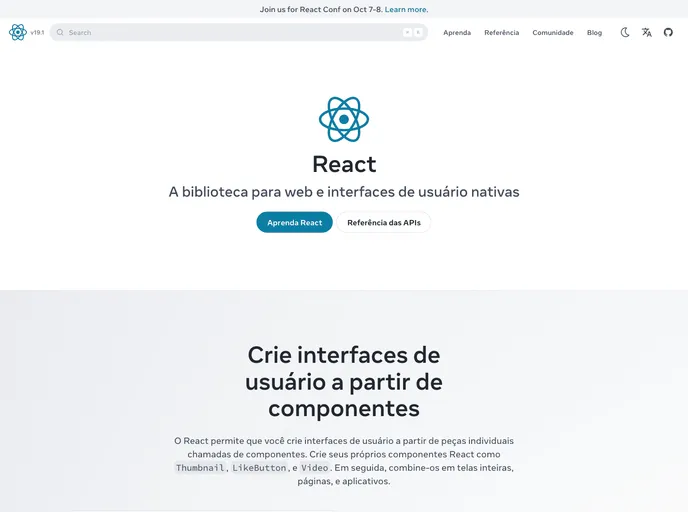


React documentation website in Portuguese (Brazil)
Overview
The pt-br.react.dev repository serves as a centralized hub for the source code and documentation related to the Brazilian Portuguese version of React. This platform is particularly beneficial for developers keen on contributing to the React ecosystem and seeking to enhance their skills in a collaborative environment. With a straightforward setup process, users can start exploring the functionalities of the site locally in no time.
The project leverages modern web technologies and provides a robust framework for developers. It encourages community contributions and offers clear guidelines to ensure that changes can be made efficiently and effectively. This repository is not just a resource for developers; it also stands as a testament to the global reach and adaptability of the React library.
Features
- Easy Setup: The project can be quickly initiated by following simple installation steps that involve only a few commands and prerequisites like Git and Yarn.
- Local Development: Developers can run the website locally using
yarn dev, allowing instant feedback and a convenient testing environment. - Hot Reloading: Changes made to React components or markdown files update instantly without needing to restart the server, streamlining the development process.
- Branch Management: The forking and branching processes are clearly outlined, making collaboration with others straightforward and effective.
- Cross-Browser Testing: Guidelines encourage testing across various browsers and devices to ensure compatibility and enhance user experience.
- Contribution Guidelines: Clear instructions are available for contributors, including writing styles and visual changes, fostering a productive collaboration.
- Open for Translation: The repository encourages translation contributions, showcasing the initiative to reach a broader audience and enhance accessibility.
- CC-BY-4.0 License: Content submitted to the repository is licensed under CC-BY-4.0, granting a flexible framework for usage and redistribution.
- Next.js
Next.js is a React-based web framework that enables server-side rendering, static site generation, and other powerful features for building modern web applications.
- React
React is a widely used JavaScript library for building user interfaces and single-page applications. It follows a component-based architecture and uses a virtual DOM to efficiently update and render UI components
- Tailwind
Tailwind CSS is a utility-first CSS framework that provides pre-defined classes for building responsive and customizable user interfaces.
- Headless UI
Headless UI is a set of completely unstyled, fully accessible UI components for React, Vue, and Alpine.js that empower developers to build their own fully accessible custom UI components. Headless UI allows developers to focus on building accessible and highly functional user interfaces, without the need to worry about styling or layout.
- Eslint

ESLint is a linter for JavaScript that analyzes code to detect and report on potential problems and errors, as well as enforce consistent code style and best practices, helping developers to write cleaner, more maintainable code.
- MDX

MDX is a format that allows developers to write JSX within Markdown documents, combining the power of React with the simplicity of Markdown. This allows for the creation of dynamic and interactive content that can be easily shared and consumed across different platforms and devices.
- Postcss

PostCSS is a popular open-source tool that enables web developers to transform CSS styles with JavaScript plugins. It allows for efficient processing of CSS styles, from applying vendor prefixes to improving browser compatibility, ultimately resulting in cleaner, faster, and more maintainable code.
- Typescript

TypeScript is a superset of JavaScript, providing optional static typing, classes, interfaces, and other features that help developers write more maintainable and scalable code. TypeScript's static typing system can catch errors at compile-time, making it easier to build and maintain large applications.