Mengke.me
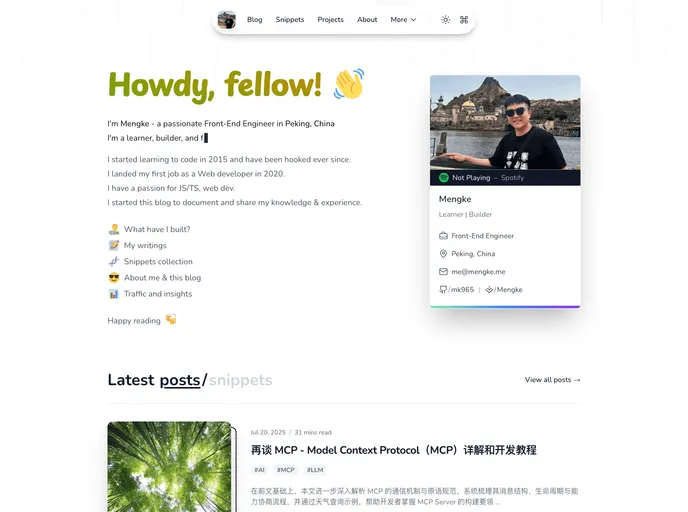




My on the . Portfolio, showcases, snippets, and development logs
Overview
This blog stands as a testament to the journey of a passionate software engineer who aims to not only share knowledge but also reflect on personal growth and learning. It blends technical insights with personal anecdotes, making it a valuable hub for web development enthusiasts. With a robust tech stack and a focus on clarity, the blog serves both as a resource and as a way to engage with others interested in technology.
By organizing thoughts and learnings, the blog not only reinforces the writer's understanding but also provides a treasure trove of information for readers. The author's call for feedback underscores a commitment to continuous improvement and collaboration, which adds a unique touch to the whole experience.
Features
-
Tech Stack: Hosted on Vercel, built with modern frameworks like React 18+ and NextJS 14+, ensuring a smooth and dynamic user experience.
-
Analytics: Utilizes Umami for website analytics, allowing for data-driven insights into traffic and engagement.
-
Typescript Support: Adopts Typescript, enhancing code quality and maintainability while committing to Conventional Commits.
-
Easy Deployment: Clear steps for cloning and deploying a similar blog, making it accessible for fellow developers looking to share their work.
-
Database Integration: Allows for visitor tracking through a PostgreSQL database, automatically counting views for each blog post, which is useful for content evaluation.
-
Community Engagement: Actively encourages reader comments and feedback to foster a sense of community and collaboration.
-
User-Friendly Setup: Offers a straightforward installation process that caters to both novice and experienced developers looking to set up their own blogs.
- Next.js
Next.js is a React-based web framework that enables server-side rendering, static site generation, and other powerful features for building modern web applications.
- React
React is a widely used JavaScript library for building user interfaces and single-page applications. It follows a component-based architecture and uses a virtual DOM to efficiently update and render UI components
- Tailwind
Tailwind CSS is a utility-first CSS framework that provides pre-defined classes for building responsive and customizable user interfaces.
- Headless UI
Headless UI is a set of completely unstyled, fully accessible UI components for React, Vue, and Alpine.js that empower developers to build their own fully accessible custom UI components. Headless UI allows developers to focus on building accessible and highly functional user interfaces, without the need to worry about styling or layout.
- Drizzle ORM
Drizzle ORM is a TypeScript ORM for SQL databases designed with maximum type safety in mind. It comes with a drizzle-kit CLI companion for automatic SQL migrations generation. Drizzle ORM is meant to be a library, not a framework. It stays as an opt-in solution all the time at any levels.
- Prisma
Prisma is a server-side library that helps developers read and write data to the database in an intuitive, efficient and safe way.
- Blog

Blog websites feature posts written by one or more authors, organized by categories and tags, with a section for comments and archives sorted by date or topic. Additional features may include search bar, social media sharing, subscription or RSS feed, about and contact pages, and visual content.
- Fullstack

A fullstack boilerplate provides a starter application that includes both frontend and backend. It should include database, auth, payments, user roles and other backend services to build a fully featured saas or webapps.
- MDX

MDX is a format that allows developers to write JSX within Markdown documents, combining the power of React with the simplicity of Markdown. This allows for the creation of dynamic and interactive content that can be easily shared and consumed across different platforms and devices.
- Postcss

PostCSS is a popular open-source tool that enables web developers to transform CSS styles with JavaScript plugins. It allows for efficient processing of CSS styles, from applying vendor prefixes to improving browser compatibility, ultimately resulting in cleaner, faster, and more maintainable code.
- Typescript

TypeScript is a superset of JavaScript, providing optional static typing, classes, interfaces, and other features that help developers write more maintainable and scalable code. TypeScript's static typing system can catch errors at compile-time, making it easier to build and maintain large applications.