
React Content Loader


SVG-Powered component to easily create skeleton loadings.
Overview:
This SVG-Powered component allows users to easily create placeholder loadings similar to Facebook's card loading. The component is highly customizable, lightweight, and supports both web and React Native platforms.
Features:
- Customizable: Change colors, speed, sizes, and even support RTL.
- Plug and play: Comes with presets for easy use.
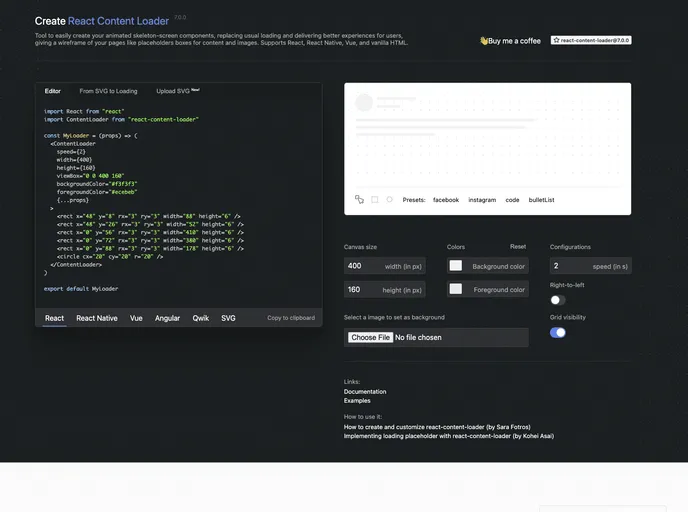
- DIY: Create custom loaders easily with the create-content-loader tool.
- React Native support: Same API with powerful features.
- Really lightweight: Less than 2kB with 0 dependencies for the web version.
Summary:
This SVG-powered component provides a convenient way to create placeholder loadings, offering customization options, presets for easy use, and support for both web and React Native platforms. With its lightweight nature and DIY capabilities, users can easily create unique loaders to enhance their applications.
- React
React is a widely used JavaScript library for building user interfaces and single-page applications. It follows a component-based architecture and uses a virtual DOM to efficiently update and render UI components
- React Native
React Native is a framework for building mobile applications using React and JavaScript. It enables developers to write once and deploy to multiple platforms, including iOS, Android, and the web, while providing a native app-like experience to users.
- Rollup

RollupJS is a popular and efficient JavaScript module bundler that takes the code from multiple modules and packages them into a single optimized file, minimizing the overall size of the application and improving its performance.
- Storybook
Storybook is a tool for developing and testing UI components in isolation. It provides a sandbox environment where you can experiment with different props and states to see how your component responds.
- Typescript

TypeScript is a superset of JavaScript, providing optional static typing, classes, interfaces, and other features that help developers write more maintainable and scalable code. TypeScript's static typing system can catch errors at compile-time, making it easier to build and maintain large applications.