Opendata.cern.ch
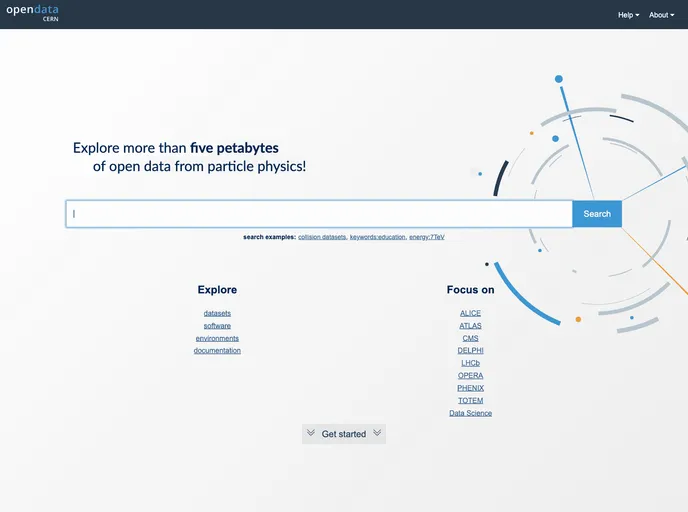

Source code for the CERN Open Data portal
## Overview
The CERN Open Data portal is an impressive initiative that provides an extensive range of scientific data collected from various experiments conducted at CERN. By allowing open access to this data, it encourages collaboration and innovation among researchers, educators, and the general public. The platform serves as a valuable resource for anyone interested in understanding the universe, particle physics, and data analysis methodologies.

This repository of data is not just about the numbers; it embodies the spirit of scientific inquiry and transparency. By making data freely available, CERN is opening its doors to the global community, fostering learning and discovery far beyond the walls of the laboratory.

## Features
- **Open Access**: The portal includes a wealth of data publicly available for anyone to access, facilitating independent research and learning.
- **Comprehensive Datasets**: It features data from significant experiments, such as those conducted by the Large Hadron Collider, covering a wide range of topics in particle physics.
- **User-Friendly Search Interface**: The site is designed with an intuitive search feature that allows users to quickly find relevant data sets based on various parameters.
- **Educational Resources**: Includes tutorials and guides to help users understand how to work with the data, making it easier for educators and students.
- **Community Engagement**: Researchers and enthusiasts can collaborate and share findings, promoting a sense of community around open science.
- **Regular Updates**: The portal is consistently updated with new data and features, ensuring that users have access to the latest information from CERN’s ongoing research.
- **Multi-Format Data**: Offers data in various formats to cater to different user needs, whether for casual exploration or in-depth analysis.
- Flask
Flask is a lightweight and popular web framework for Python, known for its simplicity and flexibility. It is widely used to build web applications, providing a minimalistic approach to web development with features like routing, templates, and support for extensions.