Igorbedesqui.com
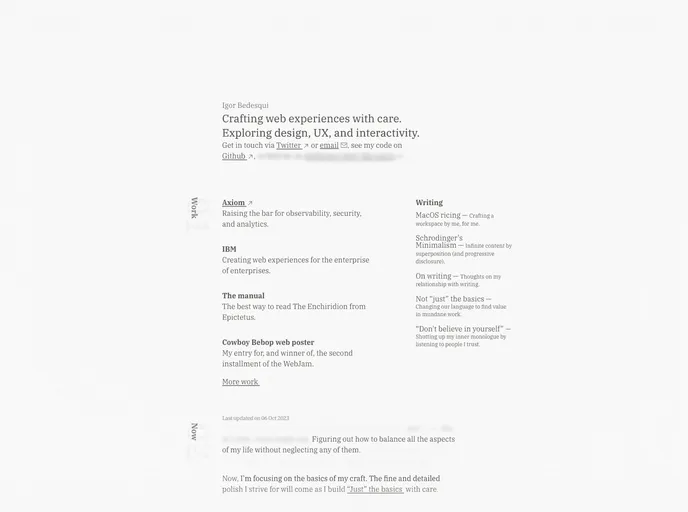


My personal website and glorified playground. Watch as I overengineer the shit out of this to learn new stuff and explore tech I find interesting.
Overview
Using Tailwind CSS with Next.js presents an efficient way to develop stylish and responsive web applications. This combination leverages the powerful utility-first CSS framework, providing developers with the flexibility to create customized designs directly within their code. The integration ensures that your project not only looks great but also performs well due to optimized CSS output.
This setup is a great starting point for anyone looking to harness the full potential of Tailwind CSS within a modern React framework. With essential PostCSS configurations included, it provides an excellent foundation for both beginners and seasoned developers alike.
Features
- Easy Setup: Bootstrap your Tailwind CSS project in Next.js effortlessly with
create-next-app, making it accessible for developers of any skill level. - Purged CSS: Automatically removes unused CSS to minimize file sizes, ensuring your application remains fast and efficient.
- PostCSS Integration: Features essential PostCSS plugins, including
postcss-preset-env, which enhances modern CSS capabilities and adds vendor prefixes. - Optimized Performance: Tailwind CSS is specifically designed to keep CSS size in check, improving load times and overall application performance.
- Responsive Design: With utility classes, you're equipped to create responsive designs quickly, adapting to different screen sizes without extra hassle.
- Customization: Tailwind CSS allows for extensive customization, so developers can easily modify styles to match the unique branding of their applications.
- Active Community: A thriving community means access to countless resources, examples, and support for integrating Tailwind CSS with various frameworks like Next.js.
- Next.js
Next.js is a React-based web framework that enables server-side rendering, static site generation, and other powerful features for building modern web applications.
- React
React is a widely used JavaScript library for building user interfaces and single-page applications. It follows a component-based architecture and uses a virtual DOM to efficiently update and render UI components
- Tailwind
Tailwind CSS is a utility-first CSS framework that provides pre-defined classes for building responsive and customizable user interfaces.
- Radix UI
Radix Primitives is a low-level UI component library with a focus on accessibility, customization and developer experience. You can use these components either as the base layer of your design system, or adopt them incrementally.
- Eslint

ESLint is a linter for JavaScript that analyzes code to detect and report on potential problems and errors, as well as enforce consistent code style and best practices, helping developers to write cleaner, more maintainable code.
- MDX

MDX is a format that allows developers to write JSX within Markdown documents, combining the power of React with the simplicity of Markdown. This allows for the creation of dynamic and interactive content that can be easily shared and consumed across different platforms and devices.
- Postcss

PostCSS is a popular open-source tool that enables web developers to transform CSS styles with JavaScript plugins. It allows for efficient processing of CSS styles, from applying vendor prefixes to improving browser compatibility, ultimately resulting in cleaner, faster, and more maintainable code.
- Typescript

TypeScript is a superset of JavaScript, providing optional static typing, classes, interfaces, and other features that help developers write more maintainable and scalable code. TypeScript's static typing system can catch errors at compile-time, making it easier to build and maintain large applications.
- Vercel

Vercel offers built-in support for deploying and hosting Next.js applications, making it a popular choice among Next.js developers.
- Zustand
Zustand is a lightweight state management library for React that provides a simple and intuitive API for managing state in your application. It allows developers to easily create and manage global state, and provides a powerful set of tools for optimizing performance and improving developer productivity. Zustand is designed to be easy to use and easy to learn, making it a popular choice for developers of all skill levels.