Jarocki.me
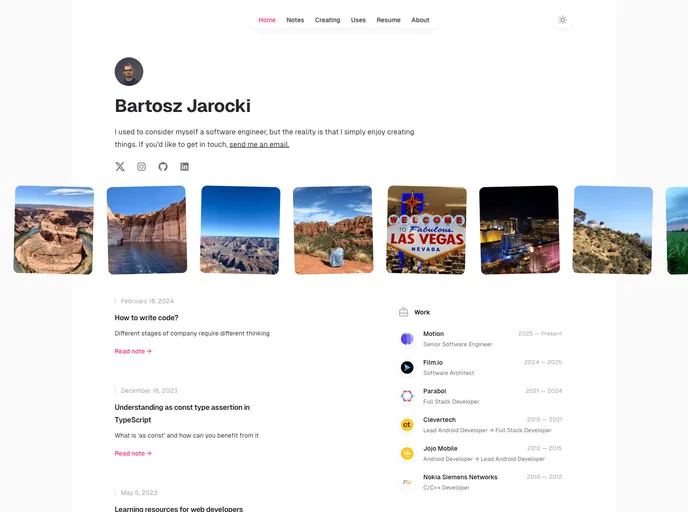


Personal website / blog / portfolio built using TypeScript, Next.js, Tailwind CSS and Notion API
Overview
The combination of Next.js and Notion as a headless CMS offers a modern and efficient approach to creating a personal website. This setup not only provides robust performance but also simplifies content management for users who prefer a non-technical solution. With a focus on speed and ease of use, this website template caters to both developers and non-developers alike.
By leveraging cutting-edge technologies like TypeScript and Tailwind CSS, the platform ensures that users can enjoy a seamless experience while navigating between dark and light modes. The implementation of SEO best practices enhances visibility, making it a compelling choice for anyone looking to establish a significant online presence.
Features
- Blazing Fast: Built with Next.js 14, this website template is optimized for incredible performance and speed.
- Notion CMS Integration: Easily manage website content through Notion, making it accessible for users without coding skills.
- Dark/Light Mode: Features automatic theme switching based on system preferences, ensuring a comfortable viewing experience.
- Fully Responsive: The design is mobile-first, allowing the website to function perfectly across all devices.
- SEO Optimized: Utilizes NextSEO, ensuring all pages are search engine friendly with automatic sitemap generation.
- Dynamic OG Images: Automatically generates Open Graph images for social media sharing, enhancing your content's visibility.
- TypeScript Support: Ensures full type safety throughout the application, reducing runtime errors and improving developer experience.
- Accessibility First: The design adheres to WCAG standards, ensuring a user-friendly experience for everyone.
- Next.js
Next.js is a React-based web framework that enables server-side rendering, static site generation, and other powerful features for building modern web applications.
- React
React is a widely used JavaScript library for building user interfaces and single-page applications. It follows a component-based architecture and uses a virtual DOM to efficiently update and render UI components
- Tailwind
Tailwind CSS is a utility-first CSS framework that provides pre-defined classes for building responsive and customizable user interfaces.
- Headless UI
Headless UI is a set of completely unstyled, fully accessible UI components for React, Vue, and Alpine.js that empower developers to build their own fully accessible custom UI components. Headless UI allows developers to focus on building accessible and highly functional user interfaces, without the need to worry about styling or layout.
- Notion
Notion is an all-in-one workspace that helps individuals and teams organize and manage their projects, notes, documents, and databases. It offers a range of features, including note-taking, task management, project planning, team collaboration, and more, all within a single app.
- Blog

Blog websites feature posts written by one or more authors, organized by categories and tags, with a section for comments and archives sorted by date or topic. Additional features may include search bar, social media sharing, subscription or RSS feed, about and contact pages, and visual content.
- Portfolio

A portfolio website is a type of website that showcases an individual's or a company's work, skills, and accomplishments. It typically includes a gallery of images or videos, case studies, and client testimonials to provide potential clients or employers with a comprehensive overview of their experience and expertise.
- Eslint

ESLint is a linter for JavaScript that analyzes code to detect and report on potential problems and errors, as well as enforce consistent code style and best practices, helping developers to write cleaner, more maintainable code.
- Framer Motion

Alpine.js is a lightweight JavaScript framework that simplifies the process of creating dynamic, reactive user interfaces on the web. It uses a declarative syntax that offers a higher level of abstraction compared to vanilla JavaScript, while being more performant and easier to use than jQuery.
- Postcss
PostCSS is a popular open-source tool that enables web developers to transform CSS styles with JavaScript plugins. It allows for efficient processing of CSS styles, from applying vendor prefixes to improving browser compatibility, ultimately resulting in cleaner, faster, and more maintainable code.
- Prism JS

PrismJS is an open-source, lightweight, and extensible syntax highlighting library that supports a wide range of programming languages and markup formats.
- Typescript

TypeScript is a superset of JavaScript, providing optional static typing, classes, interfaces, and other features that help developers write more maintainable and scalable code. TypeScript's static typing system can catch errors at compile-time, making it easier to build and maintain large applications.